
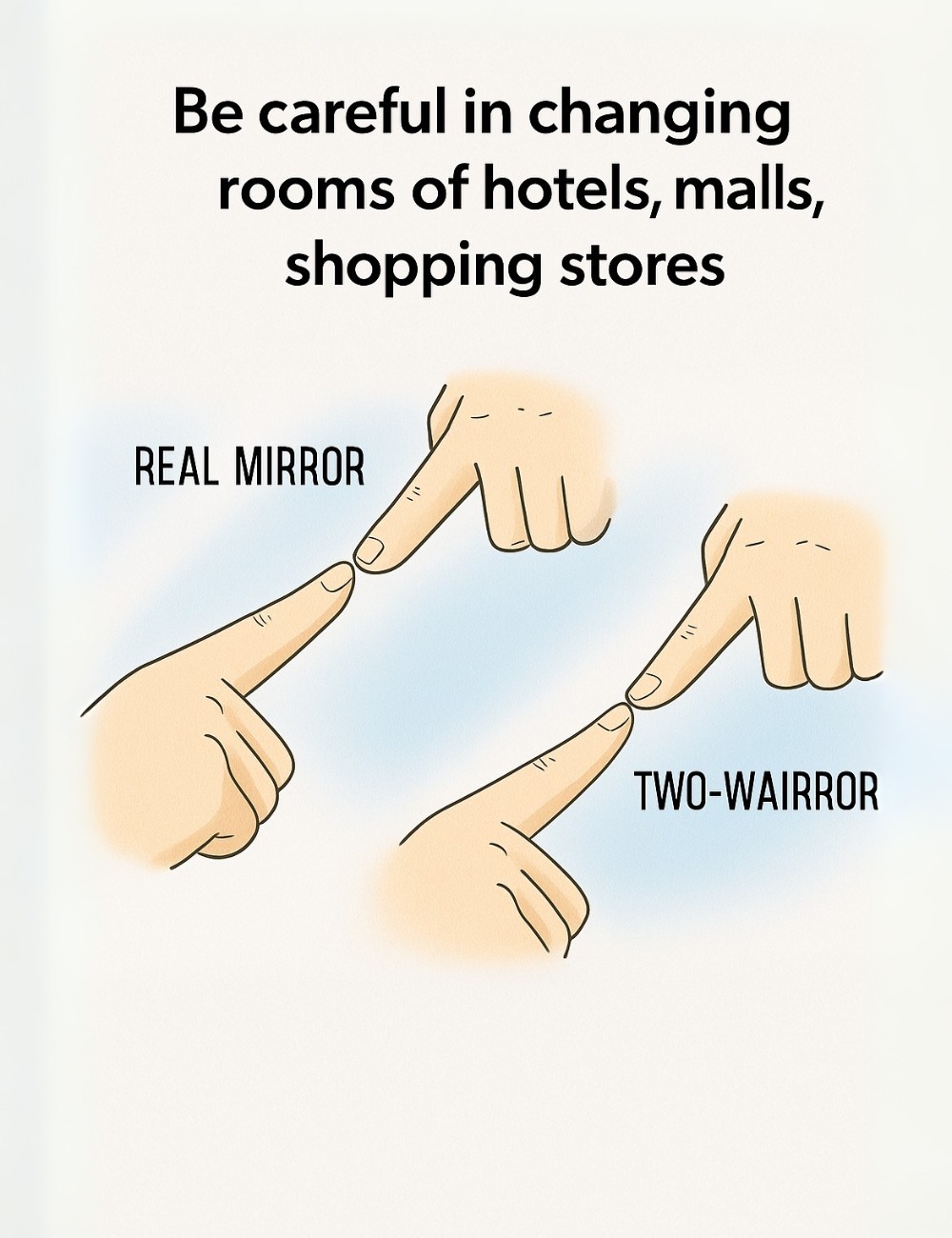
Most people step into a fitting room assuming it’s a private space—but every now and then the thought pops up: “Is this a normal mirror… or one of those two-way mirrors I’ve heard about?”
The good news is that true two-way mirrors in fitting rooms are extremely rare in modern retail stores because of strict privacy laws. Still, feeling knowledgeable and confident is empowering, and there are safe, simple ways to understand the difference between a standard mirror and a privacy-compromising reflective panel.
Here’s what you should know.
🌟 First: Debunking the Finger Test Myth
You’ve probably heard the internet-famous “fingernail test”:
Touch your finger to the mirror—if there’s a gap between your finger and its reflection, it’s a regular mirror. If not, it’s a two-way mirror.
This trick is not reliable. The presence or absence of a gap is determined by how the mirror is made, not whether someone can see you from the other side. Relying only on this method can give you the wrong answer.
So let’s look at what actually does help.
🔍 How to Safely Check Whether a Mirror Is Ordinary or a Two-Way Mirror
1. Look at the Lighting
A true two-way mirror requires the space behind it to be significantly darker than the room you’re in for the effect to work.
✔ If the room you’re in is brighter than whatever is behind the mirror, it’s almost certainly a normal mirror.
✔ Fitting rooms are typically well-lit, and storage spaces or hallways behind walls are not kept in darkness—so a two-way setup wouldn’t function.
2. Check the Installation Style
This is the most practical real-world indicator.
Regular mirrors are often mounted on the wall surface, sometimes with a frame.
Two-way mirrors used for observation (like in police interview rooms) are built into a wall like a window, not hung like décor.
Signs of a normal mirror:
Visible edges
A frame
Screws or anchors on the surface
Signs of a professional observation window:
Mirror looks flush with the wall
No visible mounting hardware
Mirror appears like part of a built-in panel, not a mounted object
Retail dressing rooms almost always use the mounted type.
3. Tap the Mirror Gently
This tip does not harm anything and won’t reveal private information—it simply helps identify how the mirror is constructed.
A standard mirror hung on the wall usually produces a sharp, solid tap.
A large panel built into a wall (like a two-way mirror) may sound more hollow, similar to tapping a window.
This is not definitive on its own, but it can offer a clue.
4. Look for Gaps Around the Mirror
A two-way mirror that functions like a viewing window must be sealed into its frame.
A typical mirror on a wall may have small gaps between the frame and wall surface. Retail mirrors often show:
A seam of glue
Clips
Mounting brackets
If you can see that it is clearly mounted, it is very likely just a mirror.
5. Observe What’s Reflected
Two-way mirrors often reflect slightly darker or duller than regular mirrors, because light passes through one side.
In bright fitting rooms, the reflection should be crisp:
If the mirror looks unusually dim, cloudy, or muted, it could simply be old or low-quality glass—this alone is not evidence of anything—but it’s one small piece of the puzzle.
⚠️ Important Reality Check
Two-way mirrors in fitting rooms are illegal in many places.
Retail stores face major legal penalties for any form of hidden observation in private areas like changing rooms and bathrooms. It is not a normal or accepted practice in the industry.
Bathroom furniture
So while the idea can be unsettling, the actual risk is very low.
