
Introduction: Why Real Honey Matters More Than You Think
Honey has been treasured for thousands of years—not just as a sweetener, but as food, medicine, and even currency. Ancient civilizations used it to heal wounds, preserve food, and honor the gods. Today, we drizzle it over toast, stir it into tea, and bake it into desserts without much thought.
But here’s the surprising truth: not all honey on store shelves is real honey.
In recent years, studies and food investigations have revealed that a significant portion of commercially sold honey is diluted, over-processed, or mixed with syrups like corn syrup or rice syrup. That’s why learning simple ways to identify real honey matters—not just for flavor, but for health, authenticity, and value.
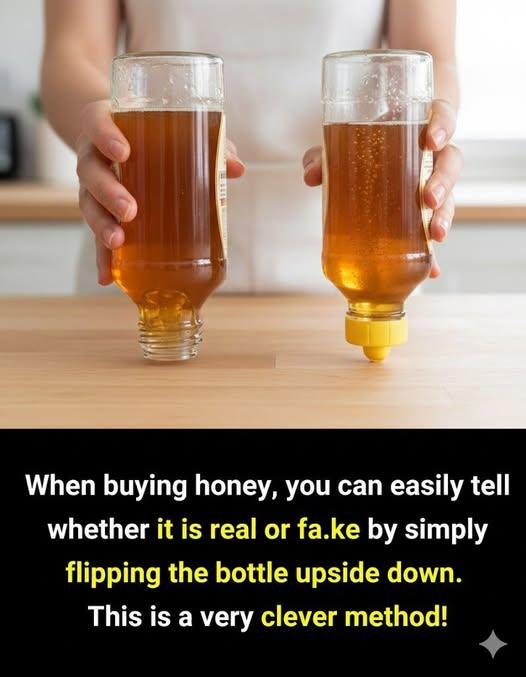
One of the simplest checks?
Turn the bottle upside down.
It sounds almost too easy—but this quick test can tell you a lot.
What “Real Honey” Actually Means
Before diving into the test, it’s important to understand what real honey is.
Pure Honey Is:
Made solely by bees
Derived from flower nectar
Naturally thick and viscous
Unprocessed or minimally processed
Free from additives or syrups
Fake or Adulterated Honey May:
Contain added sugars or syrups
Be ultra-filtered
Be watered down
Have artificial flavors or coloring
Some honey is technically “honey,” but so heavily processed that many of its natural benefits are stripped away.
Why Fake Honey Exists
You might wonder: why would anyone fake honey?
The answer is simple—money.
Producing genuine honey takes time, labor, and healthy bee populations. Diluting honey with cheaper syrups dramatically increases profit margins. Since honey is difficult to trace once processed, dishonest practices can go unnoticed.
This makes it especially important for consumers to know how to recognize authentic honey.
The Upside-Down Bottle Test Explained
The Basic Idea
One of the quickest and easiest ways to check honey’s authenticity is to turn the bottle upside down and watch how it behaves.
This test relies on one key property of real honey: viscosity.
How to Perform the Test
Make sure the honey is at room temperature
Hold the bottle upright
Turn it upside down slowly
Watch how the honey moves
That’s it.
No tools. No mess. No special equipment.
What You’re Looking For
Real Honey:
Moves very slowly
Forms thick air bubbles
Takes time to settle
Appears dense and heavy
When turned upside down, real honey doesn’t rush to the bottom. Air bubbles move upward sluggishly, almost reluctantly.
Fake or Diluted Honey:
Flows quickly
Looks watery
Bubbles move rapidly
Settles immediately
If the honey behaves more like syrup or oil, that’s a red flag.
