
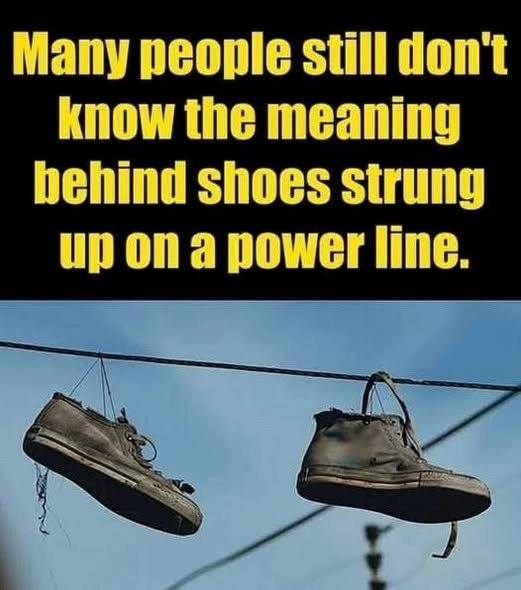
There is a certain strange, almost whimsical sight that many of us have encountered in neighborhoods, near schools, or along city streets: a pair of shoes dangling from a power line, tied together by their laces and hanging in the air like some unusual urban decoration. The sight is so common in some places that people barely even notice it anymore, yet it remains one of the most enduring urban mysteries of modern life.
What does it mean? Is it a prank, a warning, a memorial, or simply a way for someone to get rid of old shoes? The truth is, the meaning behind shoes strung up on power lines is not singular. It’s a cultural symbol with many interpretations, depending on the location, the time period, and the people involved. This article explores the fascinating history, myths, and realities behind this phenomenon.
A Visual Phenomenon With No Single Explanation
When you see shoes hanging from a wire, your first instinct may be to think of something sinister. The image has a slightly eerie quality: shoes suspended above the ground, swinging gently in the wind, almost like a ghostly pair of feet. Yet in reality, the reasons for this act range from the playful to the profound.
In many cases, the act is simply a prank or a way for teenagers to display a sense of rebelliousness. In others, it is a community ritual. Sometimes it is a way to mark a location. Occasionally it is a tragic symbol of loss or violence.
The key thing to remember is that there is no universal meaning. The significance is often local, contextual, and sometimes completely personal.
The Most Common Explanations
1. A Mark of Territory or Gang Activity
One of the most widely believed explanations is that shoes on a power line indicate gang territory or drug dealing zones. This interpretation has become especially popular in urban myths and popular culture. It is believed that gangs use this as a way to mark boundaries or to signal where drugs can be purchased.
However, while there are documented cases where this has occurred, it is not a universal rule. In many places, shoes on power lines have nothing to do with gang activity at all.
2. A Memorial for a Deceased Person
Another common interpretation is that shoes hanging on a line are a memorial for someone who has died—often a young person. The shoes may have belonged to the deceased, or they may represent a symbolic gesture to honor their memory.
This interpretation is particularly prevalent in communities where the death was sudden or violent. The shoes act as a public reminder of a life lost, a way to keep the memory visible in the community.
3. A Practical Joke or Rite of Passage
Sometimes, shoes on a wire are simply a prank. Teenagers and young adults have been known to throw shoes over power lines as a dare, as a way to mark the end of a school year, or as a form of harmless mischief.
In other cases, it is a rite of passage—throwing your shoes up onto a wire can be a symbolic act of moving on, letting go, or transitioning into a new stage of life.
4. A Symbol of Celebration
In some neighborhoods, shoes on a line can mark a celebration—graduation, an engagement, a new job, or even the birth of a child. The shoes become a public display of a personal milestone.
This is especially common in tight-knit communities where people use shared public spaces to communicate personal news and achievements.
5. Just Old Shoes
Sometimes the simplest explanation is the correct one. Shoes may be thrown over a line simply because someone didn’t know what else to do with them. If a pair of shoes is worn out, dirty, or no longer wanted, tossing them over a wire can be a quick and dramatic way to dispose of them.
The History of Shoes on Power Lines
The exact origin of this phenomenon is difficult to pinpoint. The practice seems to have emerged in urban areas during the 20th century, possibly earlier, and has spread through cultural transmission and media representation.
Some historians and sociologists suggest that the practice began as a form of urban folklore, a way for people to create symbols in the cityscape. Others argue that it started as a form of youth rebellion, a way for young people to leave their mark on a place.
The act is now so widespread that it has become a common element of modern urban landscapes in many countries.
The Power of Urban Symbols
What makes shoes on a power line so fascinating is that they are an example of urban symbolism—objects placed in public spaces that take on meaning beyond their original purpose. Like graffiti, stickers, and street art, shoes on a wire transform the environment and communicate messages that can be understood by some and remain mysterious to others.
