
What Psychology Reveals When Someone Helps the Waiter Clear the Table
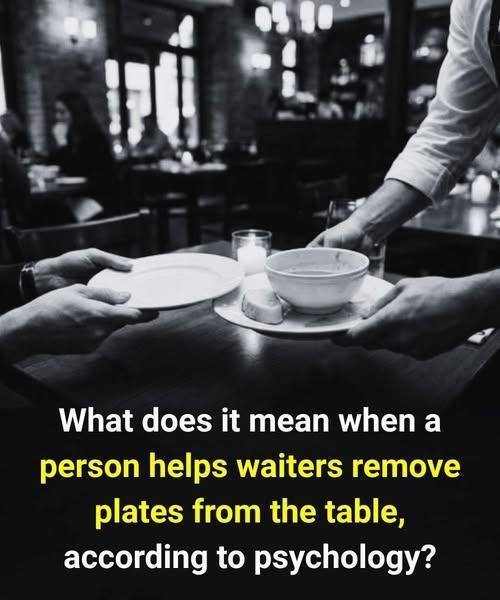
magine this scene: You’re finishing a meal at a restaurant, and before you can even think about leaving, a fellow diner instinctively reaches out to help the waiter clear the table. It might seem like a small gesture, but psychology tells us that such behavior can reveal a great deal about personality, social norms, and human motivation. In fact, acts of helping, even in subtle ways, reflect complex interactions between empathy, social cognition, and self-perception.
In this article, we explore what science and psychology reveal when someone helps the waiter clear the table. From social cues to altruism, from moral identity to cultural expectations, this behavior offers a window into human character and social dynamics.
Understanding Altruism and Prosocial Behavior
Helping behavior falls under the broader category of prosocial behavior, which psychologists define as voluntary actions intended to benefit another person. Prosocial behaviors can include donating money, offering emotional support, or performing small acts of kindness, like helping a waiter.
Theories Explaining Prosocial Behavior
Empathy-Altruism Hypothesis
Proposed by psychologist C. Daniel Batson, this theory suggests that people help others out of genuine empathy. When someone notices the waiter juggling dishes or struggling with multiple plates, an empathetic response can motivate immediate action, regardless of personal gain.
Social Exchange Theory
According to this theory, helping is motivated by a cost-benefit analysis. People may offer help because they anticipate reciprocal benefits, social approval, or a positive self-image. In a restaurant scenario, helping the waiter may not yield tangible rewards, but it can enhance one’s reputation or internal sense of being “good.”
Normative Influence and Social Responsibility
Humans are social beings, often influenced by social norms. Many cultures instill a social responsibility norm, which encourages people to help others, particularly those who depend on assistance. Seeing a waiter manage a large table may trigger this sense of obligation, prompting action.
Personality Traits Linked to Helping Behavior
Psychology research has consistently linked certain personality traits to the likelihood of helping in small, everyday contexts like clearing a table:
Agreeableness: People high in agreeableness are cooperative, compassionate, and considerate. They are naturally more likely to notice when help is needed and act on it.
Conscientiousness: Individuals who are responsible and organized may help out of a desire to maintain order and fairness in social situations.
Extraversion: Sociable and outgoing people often engage in visible helping behaviors, as they are comfortable interacting with others in public settings.
Empathy and Perspective-Taking: Those with higher empathy scores are more attuned to the needs of others, even in subtle ways, and are more likely to intervene spontaneously.
Situational Factors That Encourage Helping
Psychologists emphasize that context often shapes behavior as much as personality. Several situational factors can influence whether someone helps the waiter:
Visibility
When the behavior is public, people may feel a stronger social pressure to help. Observing others pitch in can create a contagion effect, where helping behavior spreads across the group.
Perceived Need
The more urgent the perceived need, the more likely someone is to act. A waiter balancing multiple trays or struggling with heavy plates signals higher need and triggers assistance.
Diffusion of Responsibility
In larger groups, individuals may assume that someone else will help, leading to inaction. Smaller parties or one-on-one interactions increase the likelihood that someone will step in.
Cultural Norms
In cultures emphasizing community and cooperation, helping behavior is more common and socially reinforced. In contrast, cultures that stress individualism may see less spontaneous helping unless it aligns with personal benefit or reputation.
Psychological Benefits of Helping
Helping a waiter—or engaging in any prosocial behavior—provides psychological rewards, often referred to as the “warm glow” effect.
Mood Enhancement: Acts of kindness trigger the release of endorphins, serotonin, and oxytocin, which can elevate mood and create a sense of satisfaction.
Self-Perception: People view themselves as competent, moral, or socially responsible when they help, reinforcing their self-concept.
Social Bonding: Helping fosters a sense of connection, both with the person being helped and with observers who witness the act.
Reduction of Guilt or Cognitive Dissonance: If someone perceives an imbalance—seeing someone in need—they may help to restore a sense of fairness and alleviate discomfort.
Moral and Ethical Dimensions
From a philosophical standpoint, helping the waiter touches on ethical frameworks:
Deontological Ethics: From this perspective, helping is a moral duty. A person may feel obliged to assist the waiter simply because it is “the right thing to do,” independent of consequences.
Consequentialism: Here, the focus is on outcomes. Helping benefits the waiter, improves service efficiency, and contributes to a positive social environment.
Virtue Ethics: This framework emphasizes character. A person who consistently helps reflects virtues like generosity, kindness, and empathy, signaling moral integrity.
Cultural and Social Implications
Helping behavior is not only individual; it’s social and cultural.
Hospitality Culture: In restaurants with communal dining or family-style service, helping the waiter may be more expected.
Urban vs. Rural Settings: Research suggests that prosocial behavior is influenced by environment. In smaller, close-knit communities, helping is more normative; in urban areas, anonymity and busyness may reduce spontaneous acts.
Gender Dynamics: Studies show minor differences in helping behavior based on gender, with women slightly more likely to engage in nurturing or communal help, though differences are context-dependent.
Neuroscience Behind Spontaneous Helping
Modern neuroscience sheds light on why someone might instinctively help a waiter:
Mirror Neurons: Observing someone struggling can activate mirror neurons, creating an empathetic simulation of the other person’s experience, prompting action.
Reward Pathways: Engaging in helping behavior activates the brain’s reward circuitry, reinforcing kindness and social cooperation.
Oxytocin Release: Sometimes called the “bonding hormone,” oxytocin is released during acts of prosocial behavior, increasing trust and reducing social anxiety.
Social Psychology Experiments
Several classic experiments illustrate why people help in small public situations:
The Good Samaritan Experiment (Darley & Batson, 1973)
Seminary students were more likely to help a person in need if they were not rushed, highlighting how situational pressures affect prosocial behavior.
Bystander Effect (Latane & Darley, 1968)
In emergencies, people are less likely to help when others are present, assuming someone else will act. In a restaurant scenario, a crowded table might reduce spontaneous helping.
Social Norms and Modeling
Seeing one person help can increase the likelihood that others will help—a principle known as behavioral contagion. This explains why small acts, like helping a waiter, can ripple through a dining environment.
Practical Insights
Understanding the psychology behind helping waitstaff has real-world applications:
Hospitality Training: Staff can recognize and encourage cooperative customer behaviors to improve service efficiency.
Customer Experience: Restaurants that foster an environment where small acts of kindness are normalized may enhance guest satisfaction.
Social Awareness: Individuals can become more mindful of their own actions, understanding that small gestures have psychological and social significance.
The Ripple Effect of Small Acts
Helping the waiter is more than an isolated action; it can spark a cascade of prosocial behavior:
Other diners may be inspired to help, clean, or tip generously.
Waitstaff may feel appreciated and motivated, improving overall service quality.
Children witnessing such acts learn norms of empathy and cooperation.
Even small gestures contribute to a culture of kindness, demonstrating how micro-level behavior influences macro-level social dynamics.
Beyond Restaurants: Broader Implications
The act of helping a waiter mirrors broader human behaviors:
Workplace Cooperation: Small acts of assistance foster team cohesion and morale.
Community Engagement: Volunteering or helping neighbors echoes the same psychological mechanisms.
Everyday Civility: Simple gestures, like holding a door or giving directions, operate under similar principles of empathy and social reciprocity.
By studying micro-interactions like helping a waiter, psychologists gain insights into social cohesion, moral behavior, and human motivation in everyday life.
Critiques and Complexities
While helping behavior is generally positive, psychologists note complexities:
Altruism vs. Self-Interest: Not all helping is purely selfless; some actions may be motivated by social approval or personal benefit.
Cultural Variation: What is considered polite or expected in one culture may not translate elsewhere. A gesture of helping may be interpreted differently depending on social context.
Boundaries: Sometimes helping can be intrusive or unwelcome. Understanding cues and consent is part of effective prosocial behavior.
Conclusion
Helping a waiter clear the table is a small, often unnoticed act—but it carries rich psychological meaning. It reflects empathy, moral reasoning, social norms, and even neural reward systems. Both personality traits and situational factors influence the likelihood of such behavior, and even subtle acts of help can have ripple effects across social and cultural contexts.
Whether motivated by genuine concern, social expectation, or internal reward, helping behaviors offer insight into the complex motivations that govern human interaction. These small gestures remind us that kindness and cooperation are not only culturally and socially significant but also neurologically reinforced.
Next time you see someone reaching to help a waiter, remember: this seemingly simple act is a microcosm of human psychology—an intersection of morality, empathy, culture, and neuroscience. It is a small gesture with big implications, both for the individuals involved and for society as a whole.
In the end, psychology reveals that helping is not just about the act itself; it is about who we are, how we relate to others, and the social fabric we weave with every small gesture.
