
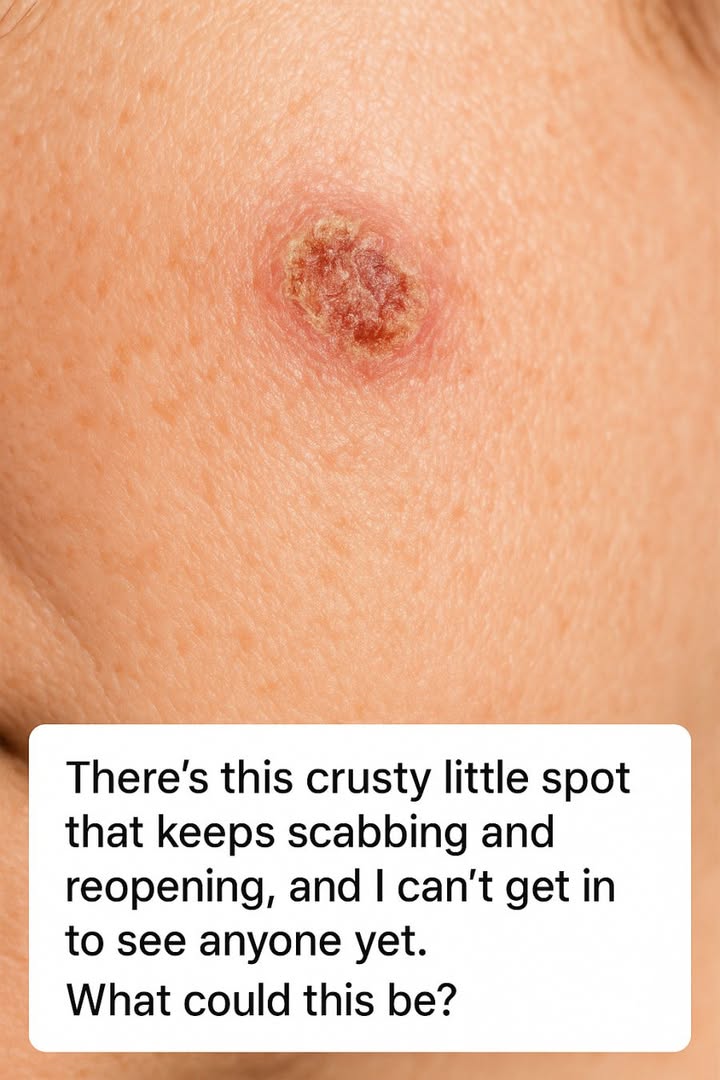
A persistent crusty spot on your skin can be a cause for concern, especially if it keeps scabbing and reopening. While you may not be able to see a healthcare professional immediately, it’s essential to understand what this could mean and how to address it in the meantime.
Understanding the potential causes of this skin condition and how to manage it at home can provide peace of mind and help prevent further irritation. This article will explore the possible reasons behind such a skin issue, focusing on actinic keratosis, a common cause, while also discussing other potential factors and interim care measures.
1. Why a Crusty, Recurrent Spot Deserves Your Attention
When a spot on your skin continues to scab and reopen, it deserves your attention because it could be a sign of an underlying condition that needs medical evaluation. Persistent skin lesions can be more than just a cosmetic concern; they might indicate a precancerous condition or even an early stage of skin cancer.
It’s important to monitor these spots closely, paying attention to any changes in size, color, or texture. A spot larger than 6mm or one that has an irregular border or multiple colors should be examined by a healthcare professional as soon as possible. Early detection and treatment are key to preventing more serious outcomes.
2. Actinic Keratosis: The Most Likely Culprit Behind a Persistent Scab
Actinic keratosis is a common skin condition that often presents as rough, scaly patches on sun-exposed areas of the skin. These patches can vary in size from a few millimeters to more than 2 centimeters and are typically caused by prolonged exposure to ultraviolet (UV) light.
This condition is considered precancerous, meaning it has the potential to develop into squamous cell carcinoma if left untreated. While actinic keratosis itself is not cancerous, its presence indicates significant sun damage, which is a risk factor for skin cancer. Therefore, if you suspect you have actinic keratosis, it’s important to consult a dermatologist for proper diagnosis and management.
3. How Sun Damage Over the Years Leads to These Rough, Crusty Patches
Prolonged exposure to UV rays from the sun or tanning beds can damage the DNA in skin cells, leading to the development of actinic keratosis. This damage accumulates over time, particularly in individuals with fair skin, light hair, and eyes, who are at higher risk.
The sun’s rays can penetrate the skin and affect cells’ ability to repair themselves. As a result, abnormal cells may proliferate, leading to the formation of these rough, crusty patches. Typically, these lesions appear on areas frequently exposed to the sun, such as the face, ears, neck, scalp, chest, backs of the hands, and forearms.
4. What Actinic Keratosis Looks and Feels Like in Real Life
Actinic keratosis often appears as a small, rough, dry, or scaly patch of skin. It can be flesh-colored, red, or brown, and may itch or feel tender to the touch. These spots are usually less than 1 inch in diameter but can enlarge over time.
They can feel like sandpaper when touched and may sometimes develop into a hard, wart-like surface. While most people have multiple lesions, they can vary in appearance on different parts of the body, often depending on the extent of sun exposure and individual skin type.
5. When a “Simple” Scab Could Signal Early Skin Cancer
While many scabs are harmless and result from minor injuries, a persistent, non-healing scab can be a warning sign of skin cancer, such as basal cell carcinoma or squamous cell carcinoma. These types of cancer often appear as open sores that bleed, crust, and refuse to heal.
It’s crucial to observe any scab that does not heal within a few weeks, especially if it is accompanied by other symptoms like pain, bleeding, or changes in color. Early diagnosis and treatment are critical to preventing the progression to more severe forms of skin cancer.
6. Other Common Causes: From Eczema and Psoriasis to Simple Irritation
Not all crusty spots are actinic keratosis or cancer. Conditions like eczema and psoriasis can also cause recurrent scabbing. Eczema, a chronic inflammatory skin condition, can lead to itchy, red, and inflamed patches, while psoriasis is characterized by thick, silvery scales and red patches that can itch or be painful.
Simple irritation from skin allergies, insect bites, or repeated friction can also cause similar symptoms. Identifying the underlying cause is key to finding the appropriate treatment, which may range from topical creams and ointments to lifestyle changes.
7. Viral Skin-Care Hacks That Can Make a Crusty Spot Worse
In the age of social media, numerous DIY skin-care hacks claim to cure various skin issues. However, many of these viral tips can exacerbate a crusty spot, particularly if they involve harsh ingredients or abrasive techniques.
