
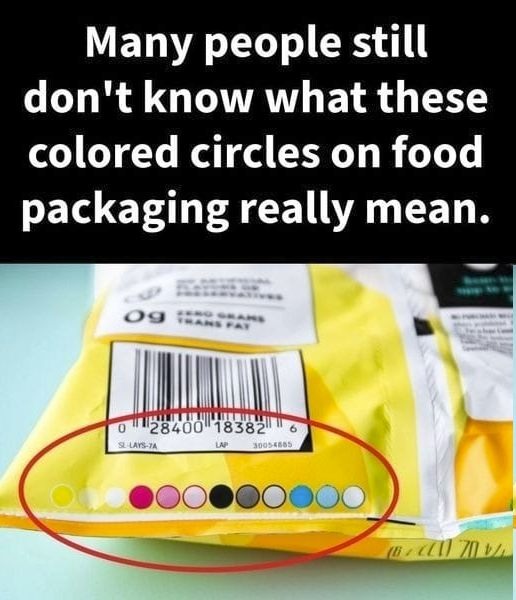
Many people still don’t know what those colored circles on food packaging actually mean—and no, they’re not about chemicals, food safety, or ingredients.
If you’ve ever noticed small colored dots or squares near the barcode or along the edge of a package, you’re seeing something called printer’s color blocks.
What Are Printer’s Color Blocks?
The colored circles—usually cyan, magenta, yellow, and black (CMYK)—are printing control marks used during the packaging production process.
They are added for printers, not consumers.
These marks help ensure that packaging colors look the same every time, whether the product is printed today or six months from now.
Why Are They on Food Packaging?
🎨 Ink Color Accuracy
Each color circle represents a specific ink used in printing. Print technicians compare these blocks to approved standards to confirm that:
The correct ink colors are being used
The shades are accurate
No colors are missing or off-balance
🛠 Print Quality Control
The blocks also help detect issues like:
Smudging
Uneven ink coverage
Faded or dull printing
If something is wrong, it shows up in the color blocks first—saving thousands of packages from being misprinted.
What These Colored Circles Do NOT Mean ❌
Let’s clear up the most common myths:
❌ They do not indicate toxic chemicals
❌ They do not reflect food quality
❌ They do not show nutrition levels
❌ They do not mean the food is unsafe
They never touch the food and have zero connection to what’s inside the package.
Why Are They Near the Edge or Barcode?
Printer’s color blocks are placed in areas that are:
Easy for machines to scan
Often trimmed during final packaging
That’s why they usually appear near edges, seams, or barcodes.
The Bottom Line
Those mysterious colored circles are simply printing tools—not secret codes.
Next time you see them, you’ll know:
They’re about ink consistency, not food safety.
